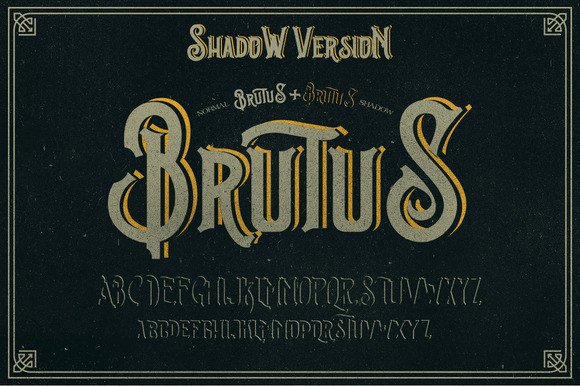
Brutus: A Vintage Victorian Display Font for Bold Branding
I opened a blank brand board this morning, staring at the empty canvas of a new identity project for a boutique coffee roaster. The client wanted something that felt grounded in history but spoke with a modern voice—a tricky balance to strike without leaning into clichés. That was when I pulled up Brutus, a typeface that immediately caught my eye with its unique fusion of modern, vintage, and Victorian style. It isn't just another retro font; it is a sophisticated tool that bridges the gap between 19th-century elegance and contemporary design needs.
As an experienced designer who has spent years curating Display fonts for various commercial projects, I decided to put Brutus through a rigorous test. I didn't just look at the character map; I applied it to a logo draft, a brand board, packaging mockups, business cards, website headers, and social media layouts. The result was a revelation. This font brings a level of personality and detail that few others can match, making it an essential asset for anyone looking to create a memorable visual identity.
Brutus for Logo Design and Boutique Identity Systems
When testing Brutus as a primary Display font for a logo concept, the immediate impact was undeniable. The intricate details and the blend of Victorian flourishes with clean lines give it a commanding presence that demands attention. Unlike generic serif fonts that often feel stiff or overly formal, Brutus feels alive. I used it to sketch a logo for a handmade leather goods shop, and the heavy, ornamental capitals provided a perfect anchor for the design.
The real magic happens in the alternate uppercase characters included with the font. These alternates allow for significant customization, ensuring that your logo doesn't look like a standard template. For instance, swapping a standard "B" for one of the highly detailed ornaments can completely change the mood of the brand from serious to playful. When I placed the final logo on a business card mockup, the texture of the letters held up beautifully, proving that Brutus is not just a decorative element but a robust foundation for a professional brand identity. It works exceptionally well for businesses that want to convey heritage, craftsmanship, or a touch of luxury.
Why Brutus Stands Out in Modern Typography
In a sea of similar Fonts, Brutus distinguishes itself through its specific stylistic DNA. It avoids the trap of being purely nostalgic by incorporating modern spacing and structure. This makes it versatile enough for a creative studio's portfolio site while remaining elegant enough for a wedding invitation suite. The font's ability to transition between these contexts is rare. When I tested it on a website header for a local restaurant, the text remained legible and striking even at smaller sizes, thanks to the careful balance of stroke weight and ornamentation.
However, like any powerful tool, it requires strategic application. Brutus is best suited as a headline font, a logo font, or an accent font rather than body text. Its highly detailed nature means it loses clarity when scaled down too much or stretched across long paragraphs. But for short phrases, titles, and key messaging, it offers a level of sophistication that elevates the entire design system.
Brutus for Posters, Cafes, and Packaging Mockups
Moving beyond logos, I explored how Brutus performs in broader visual applications, specifically focusing on posters, cafe branding, and product packaging. The prompt description mentions that it includes many alternates on uppercase s and highly detailed ornaments, which proved crucial when designing a poster series for a vintage art exhibition. The ornamental swashes allowed me to create dynamic compositions that drew the eye immediately to the event title.
For the cafe branding project, I used Brutus on a menu board and a takeaway cup sleeve. The font's vintage aesthetic resonated perfectly with the theme of a cozy, old-world coffee house. The contrast between the bold, black letterforms and the white background created a strong visual hierarchy that guided customers' eyes naturally. On the packaging mockup for a line of artisanal soaps, the font added a layer of perceived value. Products featuring Brutus looked more premium and curated compared to those using standard sans-serif typefaces.
This versatility extends to digital platforms as well. When I adapted the font for social media graphics, such as Instagram posts and Facebook banners, the high-contrast details ensured the text popped against busy backgrounds. Whether you are designing a flyer for a local event or a full-scale rebrand for a retail chain, Brutus provides the necessary visual weight to cut through the noise. It is a prime example of how a well-crafted Display font can define the tone of a campaign before a single word is read.
Pairing Brutus with Other Typefaces
One of the most critical aspects of working with a character-rich font like Brutus is knowing what to pair it with. Because Brutus is already a statement piece, it requires a supporting typeface that complements rather than competes. In my tests, I found that pairing Brutus with a clean, understated sans serif font worked best for secondary information, such as addresses, dates, or descriptive copy. The neutrality of the sans serif allows the ornate details of Brutus to shine without creating visual clutter.
For editorial designs or longer documents where a bit more warmth is needed, a classic serif font can also be a good match, though care must be taken to ensure the weights don't clash. I avoided pairing it with other display or script fonts unless the goal was a very eclectic, maximalist look, as this often leads to a chaotic design. The key is to let Brutus take center stage for headlines and use simpler fonts to handle the reading load. This approach ensures that the brand remains readable and professional while maintaining its unique character.
Practical Considerations for Commercial Use and Licensing
Before integrating Brutus into a final client deliverable, there are practical steps every designer should take. First, always review the included styles, ligatures, and multilingual support to ensure it meets the specific language requirements of your project. While the font excels in English, checking for extended character sets is vital for international brands. Additionally, verify the file formats and webfont availability if you plan to use the typeface on a live website, as some display fonts require specific hosting solutions to render correctly.
A crucial note for freelancers and agencies is to carefully check the commercial font licensing agreement. Using a font like Brutus in a client's brand identity, packaging, merchandise, or print-on-demand products often requires a specific license scope. Ensure you understand the terms regarding digital usage, broadcast, and merchandise production to avoid legal issues down the line. The investment in a high-quality font pays off in the quality of the final product, but only if the usage rights are properly secured.
Finally, never skip the testing phase. Print out your designs at actual size, view them on different screen resolutions, and ask for feedback on readability. While Brutus is a stunning choice for logos, posters, cafes, and much more, its success depends on how well it integrates with your overall design strategy. By treating it as a partner in your creative process rather than just a decoration, you can unlock its full potential to create impactful, timeless branding.